

7 mins read
09 Oct 2026
A 10-billion-year-old radio signal reaches Earth
Astronomers have announced the discovery of the most distant fast radio burst ever detected, with the record-breaking signal offering a glimpse of the early Universe.
In the late 2000s, while reviewing archival radio observation data of the Magellanic Clouds taken by Murriyang (CSIRO Parkes radio telescope), undergraduate student Ash Narkevic noticed something odd. A bright, very short-duration single pulse of radio waves that originated much further away in the cosmos than anything local to our Galaxy (by about 10 times). It was so bright that it originally saturated the telescope's equipment, and the software flagged it as local radio-frequency interference.
This extremely short, yet extremely bright signal turned out to be something relatively new in astrophysics.
Today we know this event as the ‘Lorimer Burst’, after Ash’s supervisor, Prof. Duncan Lorimer, who helped (along with Prof. Maura McLaughlin and Prof. Matthew Bailes) determine what this anomaly was.
The phenomenon would later be known as a ‘Fast Radio Burst’ (FRB) -- a millisecond-long, bright flash of radio waves that originated at an extragalactic distance.
To date, we still don’t know what causes FRBs, but since the Lorimer Burst, we have found many more. They’ve opened a new way to observe the Universe and given astronomers a tool to probe the matter between galaxies.

Almost 20 years after the Lorimer Burst paper was published, astronomers from the University of Sydney have led a team, announcing today the discovery of the most distant FRB ever recorded - a signal that has travelled more than 10 billion years from when the Universe was in its infancy, before reaching Earth. The new results have been published in the journal Science.
“This is an extraordinary glimpse into the distant Universe,” said Dr Manisha Caleb from the Sydney Institute for Astronomy at the School of Physics at the University of Sydney.
“We have caught a fast radio burst from a time when the Universe was only about three billion years old, and we have used that brief flash of radio light to learn about the matter it has travelled through over billions of years.”
FRB 20240304B - The Most Distant FRB
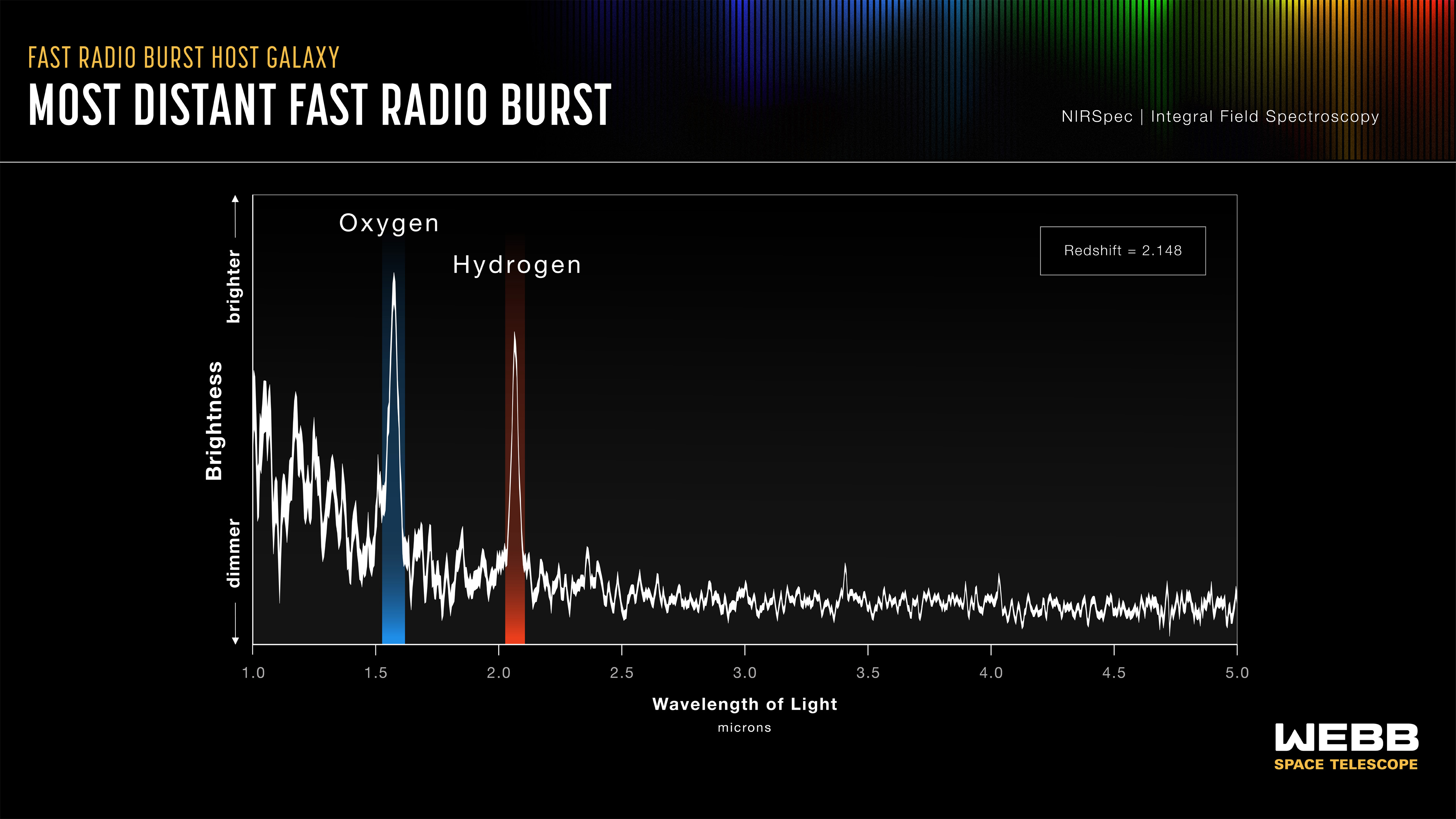
Dr Caleb and Dr Themiya Nanayakkara (who recently joined the University of Sydney) led the team that announced the discovery of FRB 20240304B. The discovery itself was first detected in March 2024 by the MeerTRAP team led by Prof. Ben Stappers at the Jodrell Bank Centre for Astrophysics, using the MeerKAT radio telescope in South Africa, which helped pinpoint its precise location in the sky. Astronomers then tried to follow up the localisation with large, ground-based telescopes at optical and infrared wavelengths, but were unsuccessful.
However, observations with the JWST, which uses powerful infrared imaging and spectroscopy, finally identified the host galaxy. The NIRCam (Near-Infrared Camera) instrument on JWST detected the galaxy at the right location, while the NIRSpec (Near-Infrared Spectrograph) provided the spectrum, which allowed the precise measurement of the galaxy’s redshift to a value of 2.148, which is approximately three billion years after the Big Bang.
“Our results further show the amazing capability of the Webb space telescope, where we can push boundaries beyond what was previously possible,” said Dr Nanayakkara.
“The galaxy hosting this burst is surprisingly small, metal-poor and undergoing a very active episode of star formation,” said co-author Dr Laura Driessen from the University of Sydney. “That gives us an important clue about the environments in which FRBs are born and shows that these brief radio flashes can tell us not only about the distant Universe, but also about how galaxies and their stellar populations evolve.”
This FRB originated when the Universe was about three billion years old and now gives astronomers a tool to study galaxy evolution in the deep past, as well as the material between the distant galaxy and Earth.
“In principle, sufficiently powerful bursts could be detectable from the very early Universe,” said Kavya Shaji, who is a PhD student at the University of Sydney and co-author.
“What is particularly exciting about our result is that we’ve now demonstrated that we can identify and study an FRB from when the Universe was young,” said Dr Caleb.
The associated galaxy with FRB 20240304B is a young, low-mass, clumpy star-forming galaxy, which provides further evidence that this FRB may originate from young magnetars.
Through their analysis, the team also found that two cosmic structures were imprinted on the FRB signal. The first is a previously unknown galaxy cluster about 3.5 billion light-years from Earth, and the other is the nearby Virgo galaxy cluster, located about 54 million light-years from Earth.
The Science of FRBs
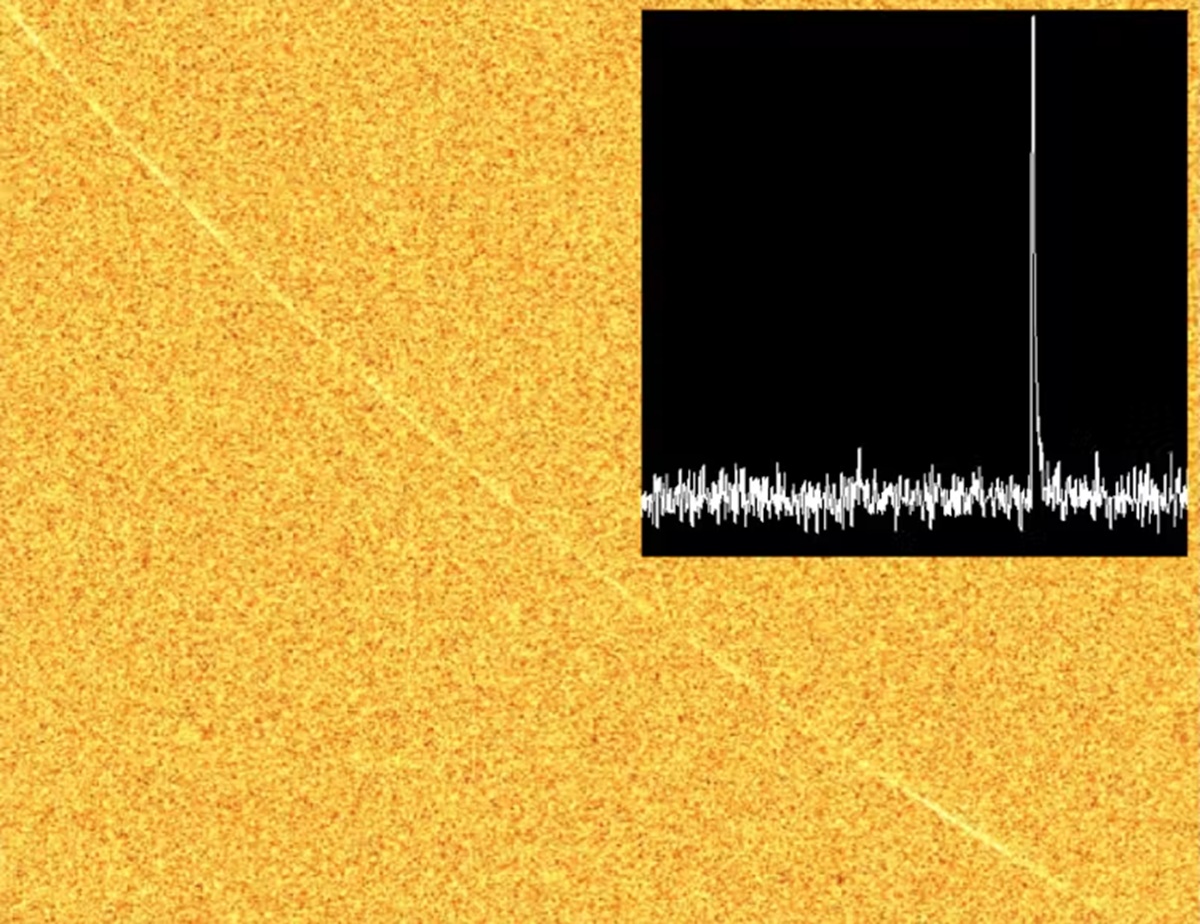
Since their discovery, astronomers have found thousands of FRBs that fall into two broad categories: apparent one-off events and recurrent events (non-repeaters and repeaters). These two categories show systematic differences, suggesting that FRBs may form in multiple ways.
While FRBs have very short timescales, their brightness is enormous -- the Lorimer Burst output the equivalent energy that the Sun releases in about a month, in just a few milliseconds. This means these bright signals can be detected across the cosmos, standing out from the dull roar of background radio noise.
While the origin of FRBs remains unclear, scientists are narrowing down what could be causing them.
“What makes fast radio bursts interesting is that we don't know what generates them. We have theories for what objects produce them, but we don't have conclusive proof,” said Dr Caleb
The short duration and brightness suggest a compact, high-energy environment that can produce coherent radio emissions. At first, astronomers thought these events were catastrophic -- destroying the source that produced them. However, the discovery of recurring bursts from the same source changed this perspective.
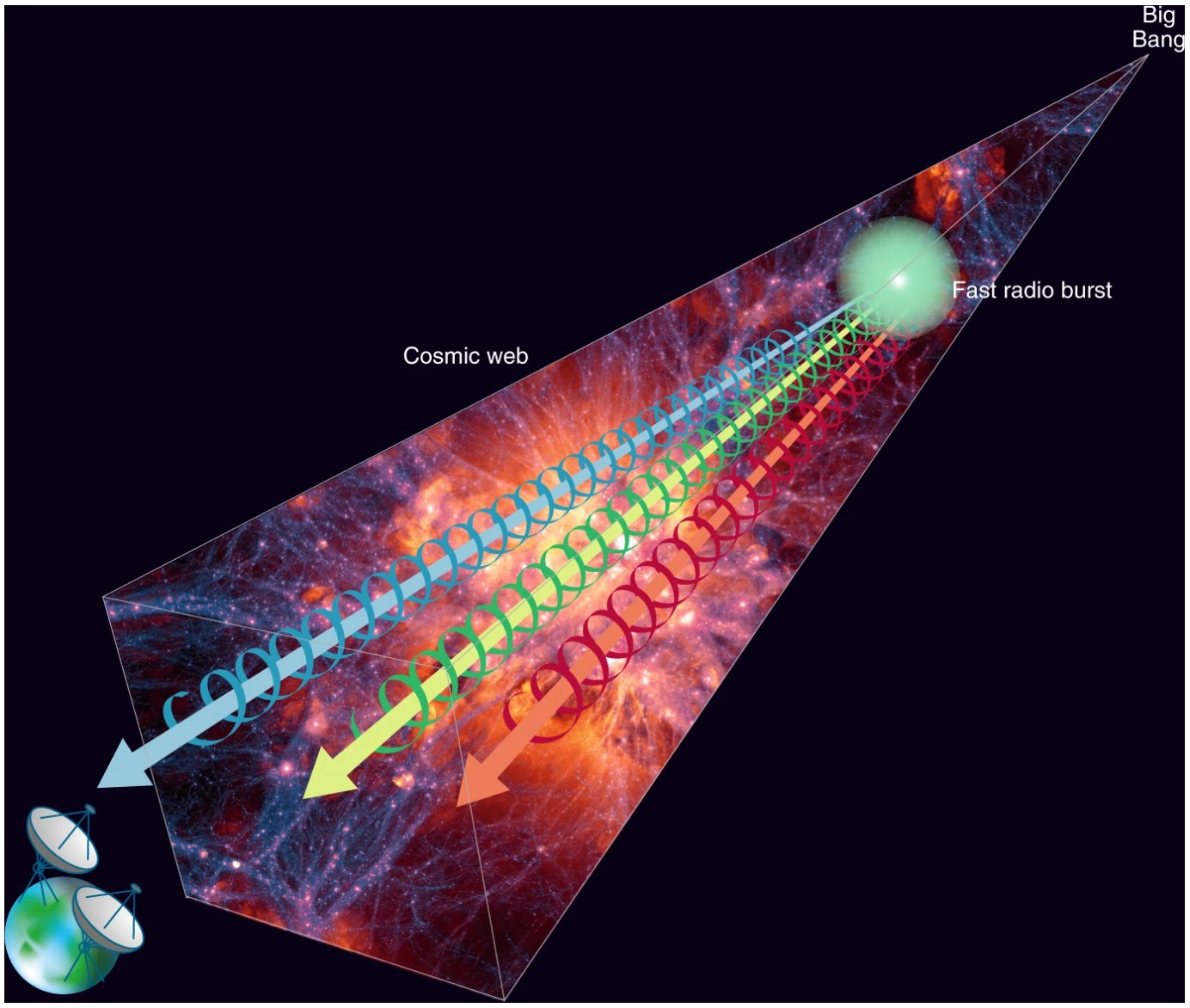
FRB signals also encode a wealth of information through their frequency dependence (how the signal varies with frequency when observed) and polarisation (the orientation of the radio waves). This allows astronomers to probe the ionised material and magnetic fields the signal encounters on its journey across the cosmos before it reaches our telescopes here on Earth.
“A fast radio burst is almost like a cosmic flashlight. It lights up everything along the path. It carries an imprint of everything that it travels through, so you can use it to trace the ‘cosmic web’ – the otherwise invisible matter and structures that it encounters along the way,” said co-author J. Xavier Prochaska of the University of California, Santa Cruz.
Proposed origins include ideas ranging from magnetars (extremely magnetic neutron stars), interacting neutron star binaries, accreting black holes, collisions between compact objects like black holes, and giant pulses from neutron stars. More exotic ideas include cosmic strings, dark matter-induced pulsar collapse, and even technosignatures from extraterrestrial civilisations.
To help narrow down what could be causing FRBs, astronomers use interferometers (a collection of telescopes that act as a single unit) like MeerKAT to localise the FRB to a region of the sky. Optical and infrared observations by ground-based telescopes and space-based telescopes like JWST can then identify the host galaxy. Researchers have now localised over 100 FRBs to their host galaxies, revealing a lot about the environments that produce them.
Probing Deeper Into The Past
While FRB 20240304B is the most distant FRB detected, it won’t be the last, in particular with much more sensitive and powerful instruments (such as the SKA) soon to come online. These short, yet powerful bursts of radio waves can now potentially give astronomers an additional tool to look further back in time and analyse how some of the earliest stars and galaxies formed, as well as the presence and behaviour of the material and structures that exist between galaxies.
“The next step is to push this frontier further and see how close we can get to the first generations of stars,” said Prof. Stappers.
What makes FRB 20240304B exciting is not only how far away it is, but that it occurred during the peak of star formation, with the radio waves' journey allowing astronomers to probe the material between galaxies across about 80% of cosmic history.
Read the paper in the journal Science
You might also like


